Remote therapeutic monitoring (RTM) is a way for a clinician to follow how a patient is getting on with a treatment between appointments, using information the patient records at home: exercises completed, pain levels, medication taken, symptom scores. It looks at the treatment and the patient's response to it, not at vital signs. The term comes from US healthcare billing, but the idea behind it, a clinician who knows what happens between visits, applies in any health system, including the NHS and private practice in the UK.
This guide explains what RTM is, how it differs from remote patient monitoring, how a programme runs in practice, what the evidence shows and how the rules differ between the US and the UK. It is written for clinicians, researchers, employers and patients who want to understand the model before deciding how to organise care between appointments.
TL;DR
- RTM means collecting non-physiological information about a treatment, such as adherence, pain and function, so a clinician can adjust care between visits.
- It differs from remote patient monitoring (RPM), which tracks physiological readings such as heart rate and blood pressure.
- A working programme depends less on technology than on routine: who looks at the information, how often, and what happens next.
- The billing codes are American. In the UK there is no single national tariff for digital monitoring, so commissioning is decided locally.
- Software used for monitoring treatment response can fall under medical device rules. Organisations should check the regulatory status of any tool they use for that purpose.
Table of Contents
- What remote therapeutic monitoring means
- RTM versus remote patient monitoring
- How an RTM programme works
- Where RTM is used
- What the evidence shows
- Rules and payment: the US codes and the UK picture
- Questions to ask before choosing a tool
- Where SwissDTx comes in
- Starting a programme: a short checklist
- FAQ
- Sources
What remote therapeutic monitoring means
The US Department of Health and Human Services (HHS) describes RTM as the capture of non-physiologic data related to a therapeutic treatment, including musculoskeletal or respiratory data, treatment adherence such as taking medication as prescribed, and treatment response such as pain management.
In plain terms: a patient is given a treatment plan, perhaps a set of physiotherapy exercises or a course of cognitive behavioural therapy. Instead of waiting until the next appointment to hear how it went, the clinician learns what the patient has done and how they feel in the days between.
That has two practical effects:
- The clinician can notice a patient who has stopped exercising, or whose pain is rising, and act early.
- The patient has a reason to stay engaged, because someone pays attention to what they report.
What kinds of information RTM uses
- Adherence: did the patient do the exercises, take the medication, complete the module?
- Function: how well can they move, walk, sleep or carry out daily tasks?
- Symptoms and response: pain, mood, breathlessness, fatigue.
- Device-generated measures: where a connected device is used, for example in respiratory care.
A 2025 peer-reviewed review in the Journal of Pain Research notes that RTM data often depend on patient input rather than automatic upload, including exercise adherence, functional status and response to therapy. The American Academy of Sleep Medicine's 2026 implementation guide adds that the data can be objective device-generated measures or subjective patient inputs, reviewed in a secure system by the billing clinician.
RTM versus remote patient monitoring
The two terms are often confused. HHS draws the line by the type of data: RTM covers non-physiologic information such as pain tolerance and medication adherence, while RPM covers physiological data such as heart rate, blood pressure and body temperature. HHS also states that RTM data can be self-reported by the patient, whereas physiological RPM data are transmitted electronically from monitoring technology.
| Remote therapeutic monitoring (RTM) | Remote patient monitoring (RPM) | |
|---|---|---|
| What it tracks | Treatment adherence and response, function, pain | Physiological readings such as heart rate, blood pressure, temperature |
| Typical data source | Patient input, sometimes a device | Connected monitoring devices |
| Typical use | Physiotherapy, rehabilitation, psychotherapy, medication adherence, respiratory care | Chronic conditions needing vital-sign surveillance |
| Main question answered | Is the treatment being followed, and is it working? | Is the patient's body staying within safe ranges? |
The two can run side by side. A patient recovering from a respiratory condition might have vital signs tracked through RPM and breathing exercises tracked through RTM. They answer different clinical questions.
How an RTM programme works
A typical programme follows the same pattern whatever the specialty. Johns Hopkins Medicine's physical medicine and rehabilitation service gives a clear example: after an evaluation, a therapist may recommend RTM alongside clinic or telehealth visits, sends a tailored home exercise programme with videos through the patient portal, and patients follow the videos, record progress and complete reminder-based surveys. The therapist tracks progress between visits and adjusts the plan. Hopkins frames it as an addition between scheduled visits, not a replacement for ordinary care.
Broken into steps:
- Assessment first. The clinician sees the patient and decides whether remote monitoring suits them and their treatment.
- Set up the plan. The clinician decides what the patient should do and record, and how often.
- Onboard the patient. The patient learns what is expected and how often the clinician will look at what they report.
- Collect information between visits. The patient completes exercises and reports, and reminders keep the routine going.
- Review and act. The clinician reviews on a set rhythm and adjusts the plan, contacts the patient or brings the next appointment forward.
- Fold the findings into the next visit. The face-to-face session starts from what actually happened rather than from memory.
The weak points are usually steps 3 and 5. If the patient is not shown what to do, or if nobody has time set aside to review, the programme becomes a data collection exercise that changes nothing.
Who is responsible for what
The AASM's 2026 guide is clear that supervised clinical staff may help with data management and coordination, while clinical interpretation, diagnosis and treatment decisions stay with the physician or other qualified health professional within their scope. Monitoring does not hand decisions to software. Decisions stay with the responsible clinician.
The 2024 systematic review in npj Digital Medicine also points out that barriers to implementation are organisational as well as technical: staff skills, operating costs, infrastructure and data-sharing arrangements all matter. A programme works best when someone owns the routine around it.
Where RTM is used
The best-documented use is musculoskeletal care. Johns Hopkins says its programme supplements physical or occupational therapy for musculoskeletal pain or functional limitations, tracking self-reported pain, function and home-exercise progress. The Journal of Pain Research review likewise describes musculoskeletal and respiratory applications, citing patient-reported data and exercise tracking as relevant modalities.
The same idea of structured work between appointments also shows up in other settings:
- Psychotherapy: between-session exercises and psychoeducation, so the next session builds on what happened during the week.
- Rehabilitation: home exercise programmes.
- Clinical trials: participants complete study tasks remotely.
- Workplace health: employers offering structured programmes to staff, with the organisation's own governance around them.
What the evidence shows
It helps to be precise here, because much of the formal evidence concerns remote monitoring in general rather than RTM alone. A 2024 systematic review in npj Digital Medicine covered 29 remote patient monitoring studies from 16 countries. It found positive results for safety and adherence, and reported downward trends in hospital admission or readmission risk, length of stay, outpatient visits and non-hospitalisation costs. The authors call for more economic and implementation evaluations.
What this means for a clinician or manager: the most consistent signal is around adherence and safe delivery of care at a distance. Evidence on cost and wider outcomes is still developing, so any programme should define from the start how it will judge success.
Rules and payment: the US codes and the UK picture
RTM is a US reimbursement concept, so most online explanations focus on American billing. Readers in the UK should know where those rules end.
United States
In the US, RTM is billed using CPT codes. The AASM's 2024 guide lists codes 98975 to 98981: 98975 for initial setup and education, 98976 for respiratory-device supply, 98977 for musculoskeletal-device supply, 98978 for cognitive behavioural therapy monitoring, and 98980 and 98981 for treatment management time. The same guide says the device-supply codes it describes depend on collecting at least 16 days of data in a 30-day period.
Things have since moved. A 2026 digital-health reimbursement report says the CY 2026 Medicare Physician Fee Schedule added codes 98984, 98985 and 98986 for device supply periods of two to 15 days across respiratory, musculoskeletal and cognitive behavioural therapy, plus 98979 for the first 10 minutes of treatment management. HHS notes that its billing guidance explains concepts but does not establish universal coverage: payment depends on the payer and programme rules. Anyone billing in the US should check the current fee schedule.
United Kingdom
The UK has no RTM code set. The same ICLG report explains that DTAC and NICE assessment inform locally made commissioning decisions, that there is no single national digital-health tariff, and that assessment does not guarantee funding. DTAC is the Digital Technology Assessment Criteria, the NHS baseline for clinical safety, data protection and technical security in digital tools.
In practice, a UK clinic, trust or private practice usually treats remote monitoring as a question of care quality and capacity, not as a billing line.
Elsewhere in Europe
A 2026 paper on the Finnish approach notes that Germany, France and Belgium have established national assessment and reimbursement approaches for digital therapies, while Finland lacked a national model at the time and launched a Digital Therapy Trial for 2025 to 2026 to inform one. The direction of travel is towards formal assessment, but the details differ by country.
Questions to ask before choosing a tool
Whatever the country, a few questions help separate what a tool does from what the care team does:
- What is the tool's intended purpose? If software is meant to monitor a patient's condition or support treatment decisions, it may be regulated as a medical device. Check the manufacturer's stated purpose and regulatory status before using a tool for that.
- Who stays in control? The clinician should decide what each patient receives and keep every clinical judgement.
- Will patients actually use it? Between-session content only helps if patients open it. Clear tasks and reminders matter.
- Does it connect to in-person care? What happens between appointments should feed the next one, not sit apart from it.
- Does it meet data protection expectations? Hosting, access rights and data-sharing arrangements should fit your organisation's rules.
Where SwissDTx comes in
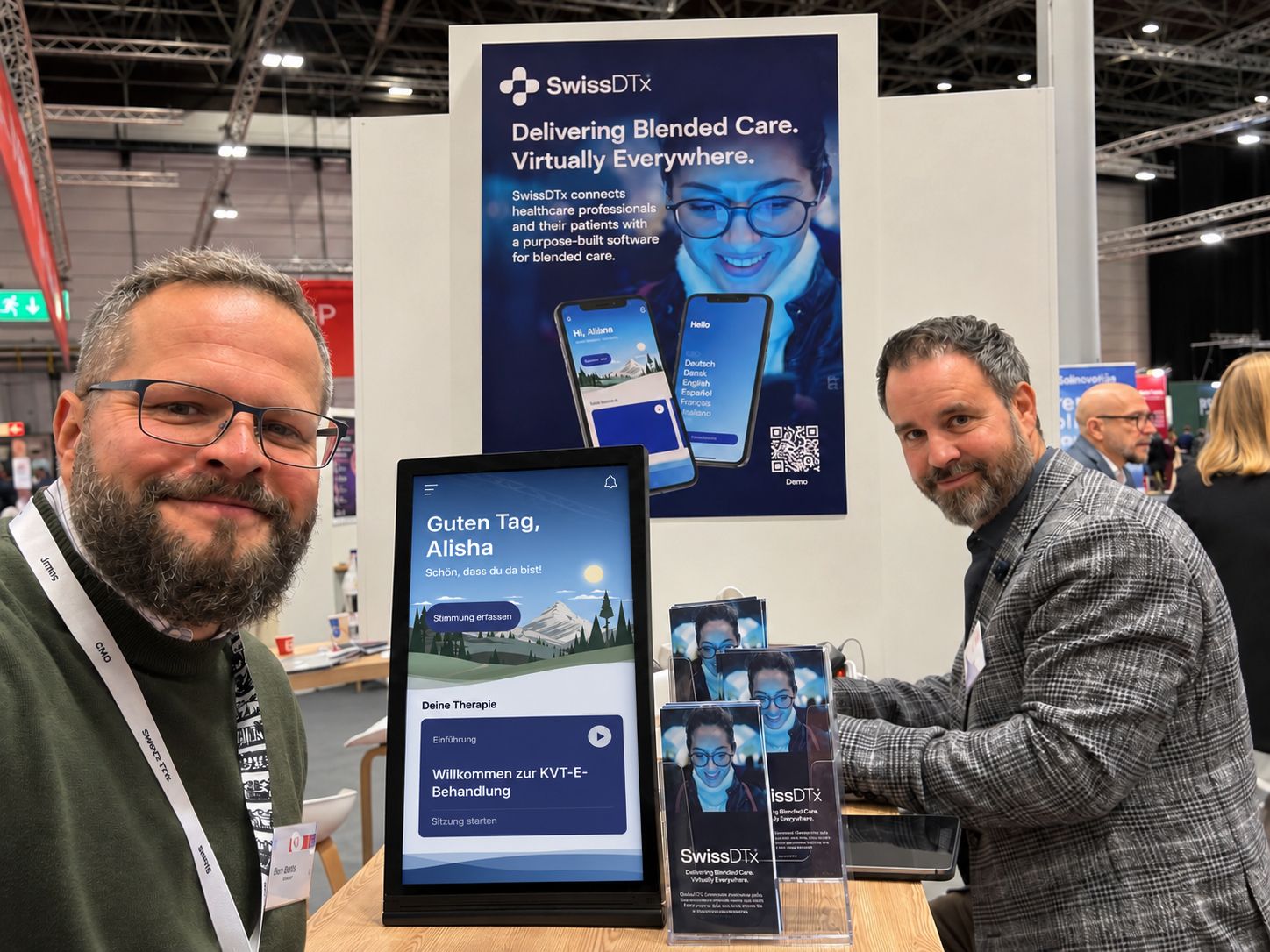
SwissDTx is a blended-care platform. It helps professionals organise the time between appointments: they put together structured content for each patient, such as psychoeducation, exercises and multimedia material, and patients work through it in the Patient App at their own pace. In the Care Cockpit, professionals manage their patients and the content they have shared with them.
SwissDTx does not interpret patient information and does not suggest diagnoses or treatment decisions. Those stay entirely with the professional. You can see the full flow on the How Blended Care Works page. The platform is used in psychotherapy and rehabilitation, in clinical research and in corporate health, so the same approach can serve a clinic, a research team or an employer. Hospitals and clinics can start from the hospitals and clinics page, and research teams from the scientific research page.
SwissDTx publishes a per-user monthly licence for the Care Dashboard, and offers the Patient App, Institutional Licenses and Scientific Research plans on request. Details are on the licences page.
If you are thinking about how to bring more structure to the time between sessions, the blog post on five signs your practice is ready for blended care is a practical starting point.
Starting a programme: a short checklist
- Pick one condition or pathway, not the whole service.
- Decide in advance how you will judge whether the programme helps.
- Decide who reviews what patients report and how often, and protect that time in the diary.
- Brief patients in the appointment and show them what to do before they leave.
- Agree how patients reach you if something comes up, and make clear that urgent problems need urgent care.
- Review after a few months.
For patients, the equivalent is simple: ask your clinician what they will look at, how often, and what you should do if you cannot complete a task. Questions about your own symptoms or medicines should always go to your clinician, and urgent symptoms need urgent care, not an app message.
FAQ
What is remote therapeutic monitoring in simple terms?
It is the practice of tracking how a patient is following and responding to a treatment, using information they record at home. Typical examples are exercise completion, pain, symptoms and medication adherence. The clinician reviews the information between visits and adjusts the plan.
What is the difference between RTM and RPM?
RTM tracks non-physiological information about a treatment, such as adherence, function and pain. RPM tracks physiological readings such as heart rate, blood pressure and temperature. HHS draws this distinction in its billing guidance, and the two can be used together.
Is there an RTM programme in the UK?
There is no UK RTM billing scheme, because the codes are American. UK services adopt remote monitoring through local commissioning or private-practice decisions, informed by DTAC and NICE assessment.
Does it replace appointments?
No. Johns Hopkins presents RTM as an addition between scheduled visits. Clinical decisions stay with the qualified professional.
Is RTM software a medical device?
It can be. Whether a tool counts as a medical device depends on its intended purpose, for example whether it is meant to monitor a condition or support treatment decisions. Check the regulatory status of any tool you plan to use for monitoring.
Sources
- Billing for remote patient monitoring, Telehealth.HHS.gov
- Reviewing the Advances in Remote Therapeutic Monitoring, Journal of Pain Research (2025)
- Remote Monitoring Services Implementation Guide 2026, AASM
- Remote Monitoring Services Implementation Guide 2024, AASM
- Remote Therapeutic Monitoring, Johns Hopkins Physical Medicine and Rehabilitation
- A systematic review of the impacts of remote patient monitoring, npj Digital Medicine (2024)
- Digital Health Laws and Regulations Report 2026, ICLG
- Development of an Assessment and Reimbursement Model for Digital Treatments, Finland (2026)