Continuity of care means that a person experiences their care over time as connected and coherent, rather than as a string of unrelated appointments.
It rests on three things: information that follows the patient, a plan that holds across settings, and a relationship with people who know them. Most breaks happen in the gaps between visits and between services, so that is where digital support alongside in-person care does the most good. SwissDTx™ is a blended-care platform that connects professionals and patients before, during and after treatment, so the gaps are covered by the same care team.
TL;DR
- Continuity of care is the degree to which a series of care events is experienced by the patient as coherent and interconnected over time, according to the WHO practice brief on continuity and coordination of care.
- It has three types: informational, management and relational. A service needs all three, because each fails in a different way.
- Research links higher continuity with fewer emergency visits and hospital admissions. Patient-reported continuity matters most.
- The moments that need the most attention are discharge, referral and the weeks after treatment. Follow-up, shared plans and patient education are the proven fixes.
- A clinician dashboard with a patient app lets a team keep contact and monitor progress between sessions without replacing face-to-face care.
What continuity of care means
The WHO practice brief defines continuity of care as the degree to which a series of discrete health care events is experienced by people as coherent and interconnected over time and consistent with their health needs and preferences. The point to hold on to is who judges it. A service can have excellent records and good pathways, but continuity exists only if the patient feels that care hangs together.
The classic multidisciplinary review by Haggerty, Starfield and colleagues (2003) makes the same distinction. Care pathways and case management are tools designed to improve continuity. They are not continuity itself. Their test is whether the individual patient experiences care as connected.
A related phrase is often confused with it. A 2019 scoping review separates the two ideas:
- Continuity of care looks at the patient's experience over time and asks: does my care feel connected? It is about the quality of the relationship and of information flow.
- Continuum of care looks at the system's range of services and asks: are prevention, diagnosis, treatment, rehabilitation and palliative care all available in sequence? It is used to plan services across a lifetime or a disease course.
The two work together. A wide continuum of services only helps if the patient can move through it without repeating their story, losing their plan or dropping out.
The three types of continuity
The Haggerty review describes three types. Nearly every other framework is a variation on them, and each one points to a different kind of fix.
Informational continuity
This is the availability and use of information about past events and personal circumstances, so that each clinician can act on what is already known. It covers records, test results, discharge summaries and also the things that never reach a record: what the patient values, what they have already tried, what worries them. When it fails, patients repeat themselves, tests are duplicated and medicines are mismatched.
Management continuity
This is a consistent, shared approach to managing a condition, so that care from different providers fits together. It matters most for long-term conditions and for anything needing several professionals, such as rehabilitation after surgery or psychotherapy alongside medication. A shared care plan, agreed goals and clear follow-up are its building blocks.
Relational continuity
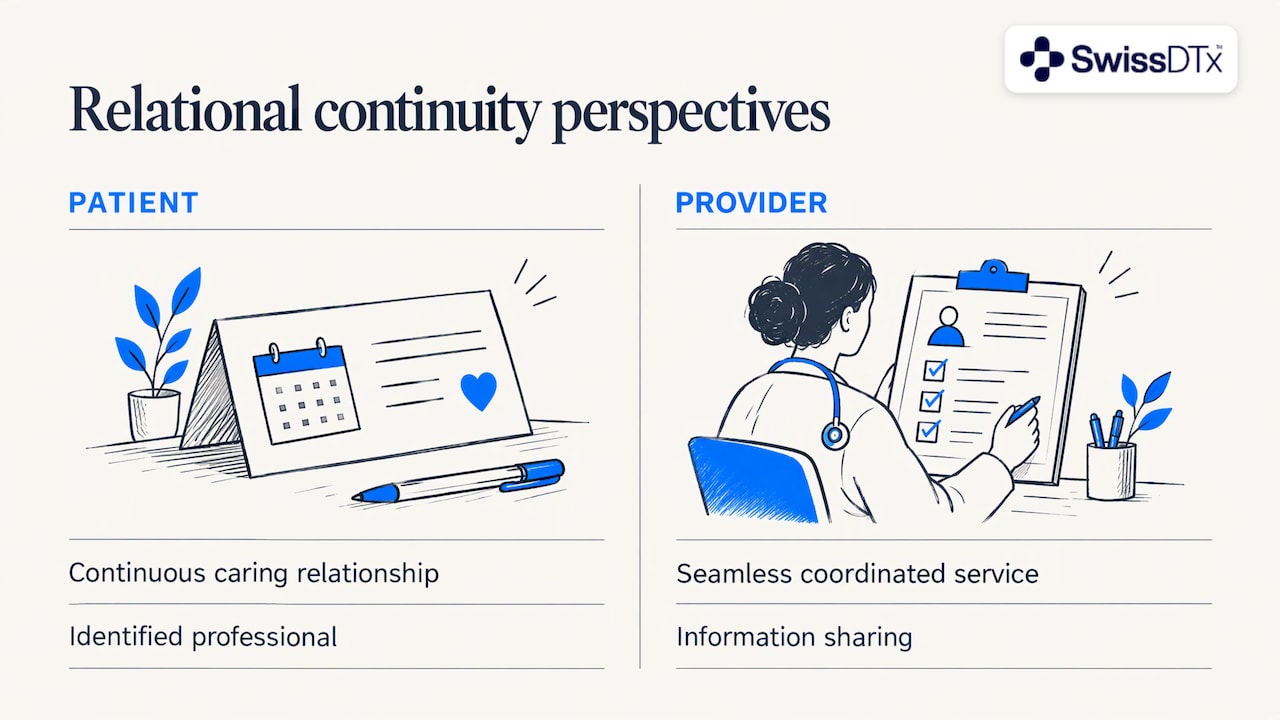
This is an ongoing therapeutic relationship between a patient and one or more providers. A 2006 paper by Gulliford, Naithani and Morgan notes that patients tend to value a continuous caring relationship with an identified professional, while providers tend to think of a seamless service built on coordination and information sharing. Both views are right, and a good service serves both.
The Brown University toolkit lists the practical markers: availability of information, constancy of clinician, a usual source of care, keeping follow-up appointments and smooth transitions between settings.
Why it matters: what the evidence shows
Continuity is not only a matter of satisfaction. Research ties it to measurable outcomes, though the strength of each finding differs, so it is worth reading the figures with their context.
- Emergency use and admissions. The WHO brief reports that high continuity is associated with 13% fewer hospital admissions and 27% fewer emergency department visits.
- Patient-reported continuity. A 2014 study of 1,219 US Medicare beneficiaries found that patients who reported higher interpersonal continuity had less emergency department use, fewer preventable hospitalisations and lower mortality. The adjusted hazard ratio for a first emergency visit in the highest tertile was 0.68. Most claims-based measures did not show the same association, which suggests that what the patient experiences is what counts.
- Family medicine. A 2024 systematic review found that greater continuity was consistently associated with lower emergency department visits and hospitalisations, and with better chronic disease management and quality of life in older people.
- Satisfaction and cost. A 2023 primer for family medicine residencies reports greater satisfaction with interpersonal continuity in 19 of 22 studies. A review of 22 studies found reduced cost or utilisation in 35 of 41 variables.
Most of this evidence is from US and primary care settings, and it describes associations rather than guaranteed results. It is consistent enough, across enough settings, to make continuity a sensible design goal for any service.
Where continuity breaks
Continuity rarely fails in the consulting room. It fails at the edges:
- Discharge from hospital. Summaries arrive late or incomplete, medicines change, and the patient goes home with a new regimen and little support.
- Referral. The receiving team lacks context, so the patient starts again.
- Between sessions. In psychotherapy or rehabilitation, weeks pass between appointments with no structured contact, and the exercises or skills practised in the room fade.
- After treatment ends. Without follow-up, relapse or non-adherence goes unseen until it becomes an emergency.
The WHO publication Transitions of Care treats these transitions as a patient safety issue. It recommends standardised referral and discharge documentation, discharge planning with agreed criteria, medication reconciliation, timely follow-up by telephone or home visit, clear clinical handovers, and care coordinators for people with complex needs. It also asks services to educate and support patients, families and carers, and to treat them as part of the team.
How services can improve continuity of care
The WHO practice brief offers a practical list: continuity with a named primary care professional, collaborative planning and shared decision-making, case management for complex needs, a single point of access, transitional care, comprehensive care along the pathway, technology to support continuity, and building workforce capability. Here is how that translates into daily practice.
Make the usual clinician the default
The Royal College of General Practitioners' guide to improving continuity suggests asking patients who their usual doctor is whenever they request an appointment, and steering medication reviews and test results back to that clinician. It also advises prioritising a patient's usual clinician over the fastest slot, unless the patient prefers otherwise or the situation is urgent. These are low-cost habits that protect the relational side.
Make follow-up routine, not optional
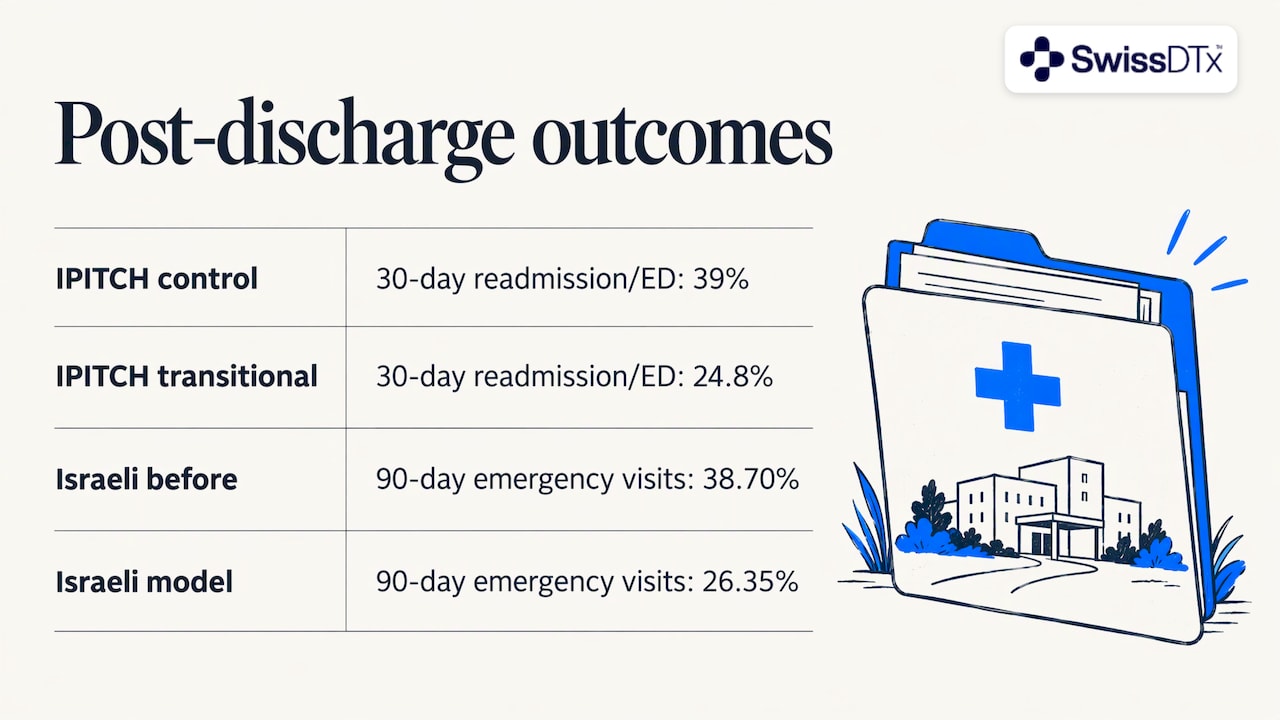
Structured contact after a transition works. In the IPITCH randomised study of 278 patients at a US academic medical centre, pharmacist-led transitional care included medication reconciliation, discharge counselling and phone calls on days 3, 14 and 30. It reduced 30-day readmission or emergency visits from 39% in the control group to 24.8%.
Mental health shows the same pattern. An Israeli study of a continuity-of-care model for severe mental illness found that emergency visits within 90 days of discharge fell from 38.70% to 26.35%. A 2025 pilot randomised trial in India found that six sessions of transitional nursing care with home visits and telephone boosters reduced symptom severity and improved medication adherence at three months compared with usual care.
The common ingredient is a planned, repeated touchpoint after discharge. Those touchpoints are exactly what a platform can schedule and track, so they do not rely on someone remembering to ring.
Share the plan, not just the record
Informational continuity is more than a shared record. The plan, the goals, the exercises and the patient's own measures need to sit where both sides can see them. Interoperable records, standard checklists and tracking for tests and referrals, as the WHO transitions guidance recommends, are the system side. The patient side is a plan they can open and understand at home.
Educate the patient and carer
A patient who knows what to expect, why a medicine changed and what a warning sign looks like can act as the link between services. That is why health literacy sits next to coordination in the WHO recommendations.
How patients and carers can help keep care connected
Patients are the one constant across every setting, so a few habits make a real difference. This is general guidance, and your own clinician can tailor it to your condition.
- Ask for your usual clinician by name when booking, and say why continuity matters for your condition.
- Keep one list of your medicines, allergies, diagnoses and recent test results, and take it to every appointment.
- Ask before you leave what happens next: who will contact you, when, and what to do if symptoms change.
- Use the exercises and tools your team gives you between visits, and report back honestly on what is working.
- Bring a carer to key appointments if you want one, and make sure they know the plan.
- Report problems early to the team that knows you, rather than waiting for the next scheduled visit.
If you are a patient and want to be more involved in your treatment, ask your clinician whether they offer a digital companion for between-session support. That conversation is itself a continuity-building step.
Where blended care fits
Blended care combines in-person treatment with digital support, so contact does not stop when the appointment ends. It speaks directly to the weak points above: the days between sessions, the weeks after discharge, and the information that stays in people's heads.
SwissDTx™ is built around this idea. It is a multimodal blended-care platform that lets health professionals and patients collaborate digitally before, during and after treatment. Clinicians use a dashboard to assign evidence-based interventions, screeners and exercises, to configure personalised care pathways and to monitor patient progress and responses. Patients use an app for continuous support and interaction with their clinicians, including exercises and multimedia content. You can see the sequence in how blended care works.
In terms of the three types of continuity:
- Informational: the clinician sees the patient's progress and responses in one dashboard, rather than relying on memory at the next appointment.
- Management: care pathways are configured for the individual and assigned as structured, evidence-based interventions, so the plan travels with the patient.
- Relational: the app keeps the patient connected to their own treating professional between visits, so the relationship is not limited to the hour in the room.
SwissDTx™ care pathways draw on structured interventions developed through collaboration between clinicians, researchers and digital product developers. The platform supports psychotherapy, rehabilitation and medication adherence, which are the areas where gaps between sessions and after discharge matter most. For services that run a ward, outpatient service or practice, the hospitals and clinics page shows how this applies in a clinical setting.
Putting it into practice: a simple plan for a clinical team
A team does not need to redesign everything at once. A workable sequence looks like this:
- Map the breaks. List the points where patients are handed over or left alone: discharge, referral, between sessions, end of treatment. Pick the one that causes most unplanned contact.
- Name an owner. Decide who is the usual clinician or coordinator for each patient, so there is always someone to ask.
- Standardise the handover. Agree what every discharge or referral summary must contain, including medicines and next steps.
- Schedule the follow-up. Set contact points in advance, in line with the transitions guidance, rather than leaving them to chance.
- Give the patient a tool. Provide the plan, exercises and a channel to the team in a form they can use at home.
- Review with the patient's view in mind. Ask patients whether care felt connected. The research suggests this is the measure that predicts outcomes best.
Steps 4 and 5 are where the Care Cockpit and the patient app do the work. The clinician configures the pathway and monitors responses, while the patient has support to hand between contacts. The step is the same as the one the evidence supports: planned, repeated contact that the patient can act on.
Offers for care teams and organisations
For professionals, the Care Dashboard licence is published at 269.– per month per user, and the Patient App, Institutional Licenses and Scientific Research plans are available on request. The licences page sets out each option, from an individual clinician to a whole institution.
Research institutions that need participants to stay engaged across a study can look at the clinical research page. Employers interested in workforce health can see the industries overview.
FAQ
What does continuity of care mean in healthcare?
It means that a patient experiences their care over time as connected and consistent with their needs and preferences. It involves information that follows the patient, a shared approach to managing their condition, and an ongoing relationship with their clinicians.
What is the difference between continuity of care and a continuum of care?
Continuity describes the patient's experience of connected care over time. A continuum describes the range of services, from prevention to palliative care, that a system provides. A good continuum supports continuity, but the patient must still feel the links.
How can continuity of care be improved?
The main levers are a usual clinician, shared care plans, standardised handovers, medication reconciliation and planned follow-up after discharge. Involving patients and carers in the plan is part of every major recommendation. Digital tools help by keeping contact going between appointments.
How can patients help maintain continuity of care?
Ask for your usual clinician, keep an up-to-date list of medicines and conditions, and ask what happens next before you leave an appointment. Use any exercises or tools your team provides, and report problems early to the team that knows you.
Sources
- Continuity and coordination of care, WHO practice brief (2018)
- Transitions of Care, WHO (2016)
- Continuity of care: a multidisciplinary review, Haggerty et al. (2003)
- How have researchers defined and used the concept of continuity of care, scoping review (2019)
- What is continuity of care? Gulliford, Naithani and Morgan (2006)
- Continuity of Care toolkit, Brown University
- The association of longitudinal and interpersonal continuity of care with emergency department use, hospitalization and mortality (2014)
- Continuity and sustainability of care in family medicine, systematic review (2024)
- Continuity of Care: A Primer for Family Medicine Residencies (2023)
- Impact of pharmacist involvement in transitional care, IPITCH study
- Long-term efficacy of a continuity-of-care treatment model for severe mental illness
- Pilot randomised controlled trial of transitional nursing care after psychiatric discharge (2025)
- Five steps to improving continuity of care, Royal College of General Practitioners