
Care coordination improves when four things are settled: who is responsible for each patient, what the shared plan says, how information moves between services, and what happens in the weeks between contacts. Tools support all four, but they do not replace the first. For teams that work in blended care, the weeks between appointments are often the least structured part of the pathway. A platform such as SwissDTx helps professionals organise that time with structured content, which they manage in the Care Cockpit and which patients work through in the Patient App at their own pace.
This guide is written for psychotherapists, physicians, nurses, service leads and researchers in Switzerland and Europe. It sets out what the evidence recommends, where coordination usually fails, and how to put practical routines in place.
SwissDTxswissdtx.comStructure the Time Between AppointmentsSwissDTx helps clinical teams share structured digital content with patients, who work through it at their own pace between appointments.VisitKey Takeaways
- Coordination is a set of agreed responsibilities and routines. The World Health Organization (WHO) recommends bundling several practices along the care pathway instead of relying on one.
- Name one person who coordinates each transition, and agree contact routes and follow-up before a patient moves between services.
- Technology works only when staff time, training and clear contact routes sit behind it.
- The time between appointments can be organised with structured content that the professional builds and reviews. SwissDTx does not interpret patient information and does not suggest diagnoses or treatment decisions.
- Measure coordination from the patient, the clinician and the system side, because each sees different failures.
Table of Contents
- What care coordination means in practice
- Where coordination breaks down
- Strategies that the evidence supports
- Who coordinates: the role of nurses and other clinicians
- Transitions between services
- Digital tools: what they can and cannot do
- Organising the time between appointments
- Where SwissDTx fits in your service
- Measuring whether coordination is improving
- A 90-day plan for a clinical team
- FAQ
- Sources
What care coordination means in practice
The WHO’s 2018 practice brief on continuity and coordination of care defines coordination as proactively bringing professionals and providers together to deliver integrated, person-focused care across settings. The word that matters is proactively. Coordination is work somebody does on purpose, not a by-product of everyone being busy and well-intentioned.
The WHO built its brief on a review that retained 81 publications for full reading: 21 systematic reviews, 39 primary empirical studies and 21 grey-literature papers. That breadth explains why its advice is a bundle of practices and not a single fix.
For a Swiss or European team the setting is familiar. A patient may see a general practitioner, an outpatient psychotherapist, a hospital department and a rehabilitation clinic within a single year, often under different organisations, different cantonal or national arrangements and different record systems. Each handover is a point where information can be lost.
Where coordination breaks down
The failures are well described. The WHO brief warns that poor coordination contributes to communication failures, inadequate sharing of clinical information, poor medication reconciliation, duplicated investigations, and avoidable admissions and readmissions. The US Centers for Medicare & Medicaid Services makes a similar point: poor communication can lead to conflicting treatment, repeat tests, medication errors, greater use of emergency care and poor transitions from hospital to home.
The Agency for Healthcare Research and Quality (AHRQ), a US agency, adds that patients and families often experience coordination failures as excessive effort during transitions: repeating their history, chasing appointments, carrying documents between services. A clinician may not see those failures at all, which is why they persist.
In practice most failures fall into a few patterns:
- Nobody owns the handover. Each service assumes another has sent the summary.
- The plan lives in one place. The goals agreed with the patient are known to one professional and not to the next.
- Contact routes are out of date. A referral goes to a departed colleague or a generic inbox.
- The interval is empty. Between appointments the patient has nothing structured to work with, and the team has nothing agreed to build on at the next contact.
Strategies that the evidence supports
The WHO recommends a bundle of practices: continuity with a usual primary-care professional, shared goal-oriented planning, case management for complex needs, single access points or colocated services, transitional care, coordination along the whole pathway, enabling technology and workforce development. It suggests bundling them along the care pathway, ideally in a comprehensive model centred on primary care.
The NSW Agency for Clinical Innovation, an Australian health body, states that a dedicated care coordinator or case manager is crucial, and that combinations of strategies are generally more successful than a single approach.
Two further papers translate this into team habits. A 2020 peer-reviewed article on improving care across boundaries, written from a UK perspective, recommends shared objectives, clear professional responsibility, engaged patients and staff, accountable leadership, staff education and relationship-building between teams. It argues that collaboration depends on shared goals and relationships across organisations, not on structural change alone.
A 2023 modified-Delphi study, a structured expert-consensus method, produced a research agenda on coordination across healthcare systems. Its recommendations are practical enough to adopt directly:
- Educate internal and external clinicians about the communication technology in use.
- Keep contact details current.
- Clarify roles.
- Hold huddles that span systems.
- Use audit and feedback.
The American College of Physicians’ 2022 paper, Beyond the Referral, recommends a care-coordination agreement between primary and specialty teams, defined internal task ownership and a lead staff member who coordinates with external teams and tracks tasks. It treats primary care as the information and coordination hub, with specialty care contributing defined expertise and keeping two-way communication open with the primary-care team.
Home care is a useful comparison for any team that works outside a hospital. A write-up on care coordination in home care shows how scheduling, call handling and documentation depend on the same discipline as clinical handovers: someone is responsible, and the routine is written down.
Who coordinates: the role of nurses and other clinicians
Coordination is not a job title only. In many Swiss and European services it is spread across nurses, case managers, psychologists, physicians and administrative staff. What matters is that the split is explicit.
The National Institute for Health and Care Excellence (NICE) guideline NG27, published in 2015, is clear on hospital discharge in England. Multidisciplinary teams should assess complex needs from admission and plan discharge together. One health or social-care practitioner should be assigned to coordinate the individual’s discharge, arrange follow-up and act as the central contact for the person, their family and the practitioners involved.
The NICE guidance is English, and Swiss cantons organise discharge differently, but the principle travels: one named person, assigned early, with a defined contact role. A US Department of Veterans Affairs systematic review describes what effective coordinators did in the interventions it examined: they used varied approaches to patient-provider communication, including coaching and role-play, and coordinators communicated with providers or attended appointments with patients.
For a service lead, the practical questions are simple:
- Who is the named coordinator for each patient, and does the patient know?
- Who covers when that person is absent?
- Which tasks belong to the coordinator and which to the treating clinician?
- Who decides, and records, that a handover is complete?
Transitions between services
Transitions are where coordination is most exposed. The NICE guideline gives concrete targets for England: the GP should receive the discharge summary within 24 hours, and people at risk of readmission should have GP or community-nurse contact within 24 to 72 hours. Whatever your national framework, the structure is worth borrowing. Agree protocols and a named contact, share assessments and medicines information, give a clear discharge plan and arrange follow-up before transfer, not after.
The AHRQ Patient Safety Network’s 2024 perspective on communication during transitions of care adds two cautions. Structured handoff tools such as I-PASS may support consistent information exchange, but checklists alone cannot guarantee a safe transition. And discharge summaries should be clear, accurate, standardised and patient-centred, and reach the receiving facility, the primary-care clinician and the patient promptly.
The American College of Physicians adds a point on closing the loop. It recommends two-way communication with acknowledgement of receipt, follow-up pathways and agreed urgency levels, with direct calls for urgent or unclear issues. It also recommends recording communications in an interoperable electronic record or other available health-information system, and transcribing relevant verbal exchanges into the record.
A checklist for your next transition review:
| Question | What good looks like |
|---|---|
| Is there a named coordinator? | One person, known to the patient and the receiving team |
| Is the plan shared? | Goals, relevant assessments and medicines information reach the next service |
| Is receipt acknowledged? | The receiving team confirms, and urgent matters go by phone |
| Is follow-up booked? | Arranged before the transfer, not left to the patient |
| Is it recorded? | Verbal exchanges are written into the record |
Digital tools: what they can and cannot do
The WHO lists shared electronic care records, technology-enabled care and decision support, and risk-prediction tools as ways to support coordination. It also names leadership, information systems, education, and financial and contractual levers as what implementation needs. The ACP describes e-consults as clinician-to-clinician consultations through a shared record or web portal that can provide specialty advice without an in-person visit where appropriate.
Both the 2023 Delphi panel and the AHRQ perspective stress the same condition: infrastructure requires staff time, training and clear contact routes, not technology alone. Digital records and handoff templates help only when teams keep data accurate, flag what needs action and speak directly where systems do not interoperate.
In Switzerland and the EU, a tool also has to fit data-protection duties. Health data is sensitive personal data, so the organisation adopting a tool should check how it fits with the Swiss revised Federal Act on Data Protection (nDSG) and, for EU services, the GDPR, and involve its data-protection officer from the start.
It helps to separate three kinds of tool, because they solve different problems:
- Records and messaging carry information between professionals.
- Decision support and prediction tools produce clinical suggestions or risk estimates.
- Content and engagement tools organise what a patient does between contacts.
Most coordination programmes need the first kind. The third is where many outpatient and rehabilitation services have a gap.
Organising the time between appointments
A handover covers the moment of transfer. Coordination also covers the weeks that follow, and the weeks between regular sessions. In psychotherapy, rehabilitation and clinical research, much of the work happens there, yet the content a patient receives is often a handful of printed sheets or ad hoc messages.
SwissDTx is a Swiss blended-care platform built for this interval. Professionals put together structured digital content for each person, such as psychoeducation, exercises, short check-ins and multimedia, and manage their patients and the content they share in the Care Cockpit. Patients work through it in the Patient App at their own pace. Programmes are built in the Therapy Builder, which now has an AI assistant that builds, translates and revises programme content. The professional always reviews the result. Programmes exist in German, French, Italian and English, which matters in a country with several official languages and in multilingual teams.
The boundaries are deliberate. SwissDTx organises content. It does not interpret patient information, and it does not suggest diagnoses or treatment decisions. All clinical judgement stays with the professional, so the platform fits alongside your existing record and your own coordination routines instead of competing with them.
In terms of the evidence above, this supports a few concrete habits:
- Shared goals become shared content. When a team agrees goals with a patient, the professional can turn them into a structured programme the patient can return to.
- Continuity across professionals. A colleague taking over a case sees which content has been shared, which helps with the clear task ownership the ACP and the Delphi panel recommend. For more on this theme, see our article on continuity of care.
- One language for the patient, one workflow for the team. Content can be translated and revised, then reviewed by the professional before it is shared.
The How It Works page shows the workflow from programme to patient, and the vision page explains the thinking behind combining human care with digital support.
Where SwissDTx fits in your service
If you lead an outpatient, rehabilitation or psychotherapy service, or run a study with decentralised elements, the question is where structured content between appointments would give your team a common routine. SwissDTx is used by hospitals, clinics, universities and research teams, in psychotherapy, rehabilitation, clinical research and corporate health.
The licences page describes the options: a Care Dashboard for professionals, the Patient App, institutional licences and a licence for scientific research. Hospitals and clinics can start from the hospitals and clinics page, and research teams from the scientific research page.
Measuring whether coordination is improving
Measurement is where many initiatives stall. The AHRQ atlas advises considering coordination from three perspectives: the patient and family, the healthcare professional, and the system. Each can experience and identify different failures, so a single indicator rarely tells the whole story.
The 2023 Delphi agenda is concrete about what services can track: referrals and follow-up, validated coordination data, workflow for closed-loop communication, and gaps or overlaps in responsibilities. These are process measures a clinic can start with immediately.
A simple starting set:
- Patient view: how many times did the patient have to repeat their history, and did they know who to contact?
- Clinician view: how often was a summary or referral reply missing when the next appointment began?
- System view: what share of transfers had follow-up arranged before the patient left, and where do responsibilities overlap or go unassigned?
Audit these quarterly, feed the results back to the teams concerned, and change one routine at a time. The 2020 cross-boundary article makes the same point about leadership: accountable leaders and patient involvement keep the effort going after the initial enthusiasm.
On outcomes, treat published figures with care. Results from one study of a bundle of strategies in a particular population do not transfer automatically to your service, so set your own baseline first and compare against it.
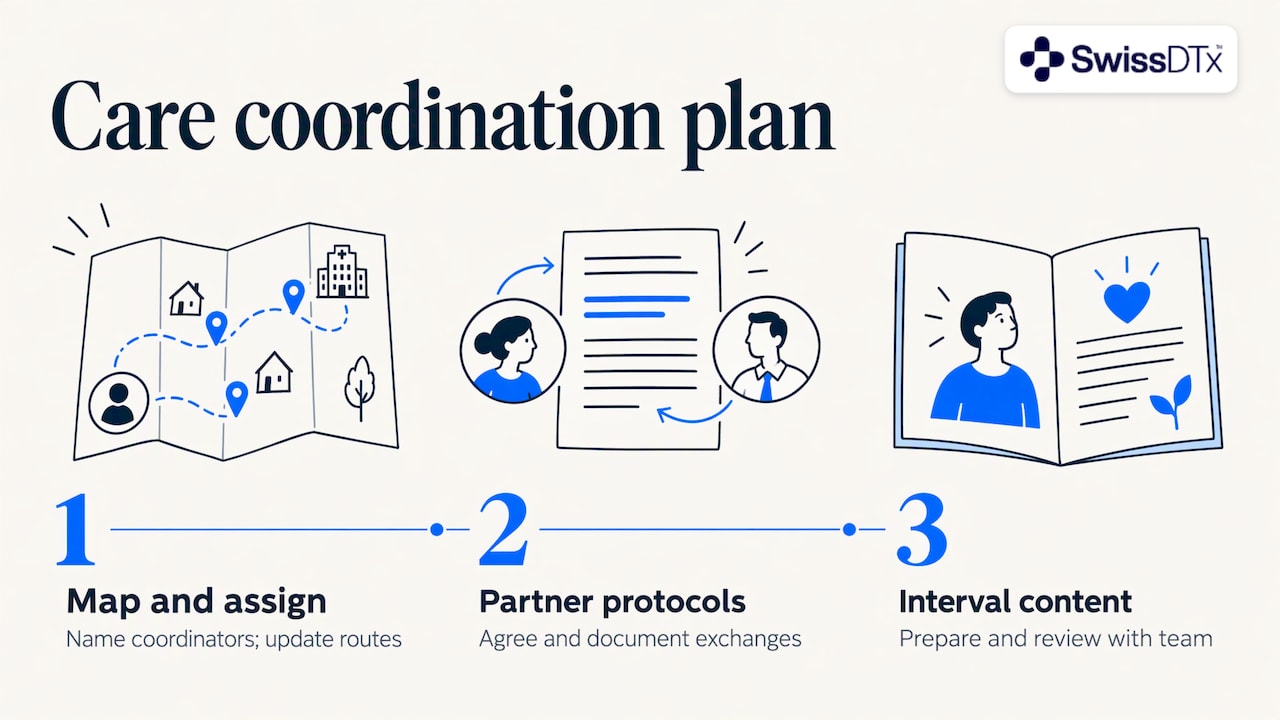
A 90-day plan for a clinical team
Weeks 1 to 4: map and assign. List the transitions your patients make, name a coordinator for each, and update every contact route. Hold a first huddle with the services you refer to most often.
Weeks 5 to 8: agree and write down. Draft a short coordination agreement with your main partners: who sends what, in which form, within what time, and how receipt is acknowledged. Decide how verbal exchanges reach the record.
Weeks 9 to 12: structure the interval. Choose one patient group, such as people in a psychotherapy course or a rehabilitation programme, and prepare structured content for the time between contacts. Review it with the team, share it, and note what the team and the patients found useful before extending it.
FAQ
What is the role of nurses in care coordination?
Nurses often hold the coordinator role or share it with case managers. NICE recommends that one practitioner is made responsible for coordinating an individual’s discharge, arranging follow-up and acting as the central contact. Whoever holds the role, it should be explicit and known to the patient.
Why is care coordination important in healthcare?
Poor coordination can lead to conflicting treatment, repeat tests, medication errors and poor transitions from hospital to home, according to the US Centers for Medicare & Medicaid Services. Good coordination means information, responsibilities and follow-up are agreed before the patient moves between services.
How can teams coordinate patient care across settings?
Combine several practices: a named coordinator, a shared goal-oriented plan, agreed contact routes, follow-up arranged before transfer and regular cross-service huddles. The WHO recommends bundling such practices along the pathway instead of relying on one.
Can technology alone improve coordination?
No. The 2023 Delphi panel emphasises that coordination infrastructure needs staff time, training and clear contact routes. Tools help when they sit inside agreed routines, and platforms such as SwissDTx organise structured content between appointments while clinical judgement stays with the professional.
Sources
- Continuity and coordination of care, WHO practice brief, 2018
- Care Coordination, Centers for Medicare & Medicaid Services
- Chapter 2. What is Care Coordination?, AHRQ
- Care coordination, NSW Agency for Clinical Innovation
- How to improve care across boundaries, 2020
- Care coordination across healthcare systems, modified-Delphi research agenda, 2023
- Beyond the Referral: Principles of Effective, Ongoing Collaboration, American College of Physicians, 2022
- Recommendations, Transition between inpatient hospital settings and community or care home settings, NICE NG27, 2015
- Care Coordination Models and Tools: A Systematic Review, US Department of Veterans Affairs, 2020
- Communication During Transitions of Care, AHRQ PSNet, 2024
- Why Care Coordination Is the Operational Spine of Every Growing Home Care Agency