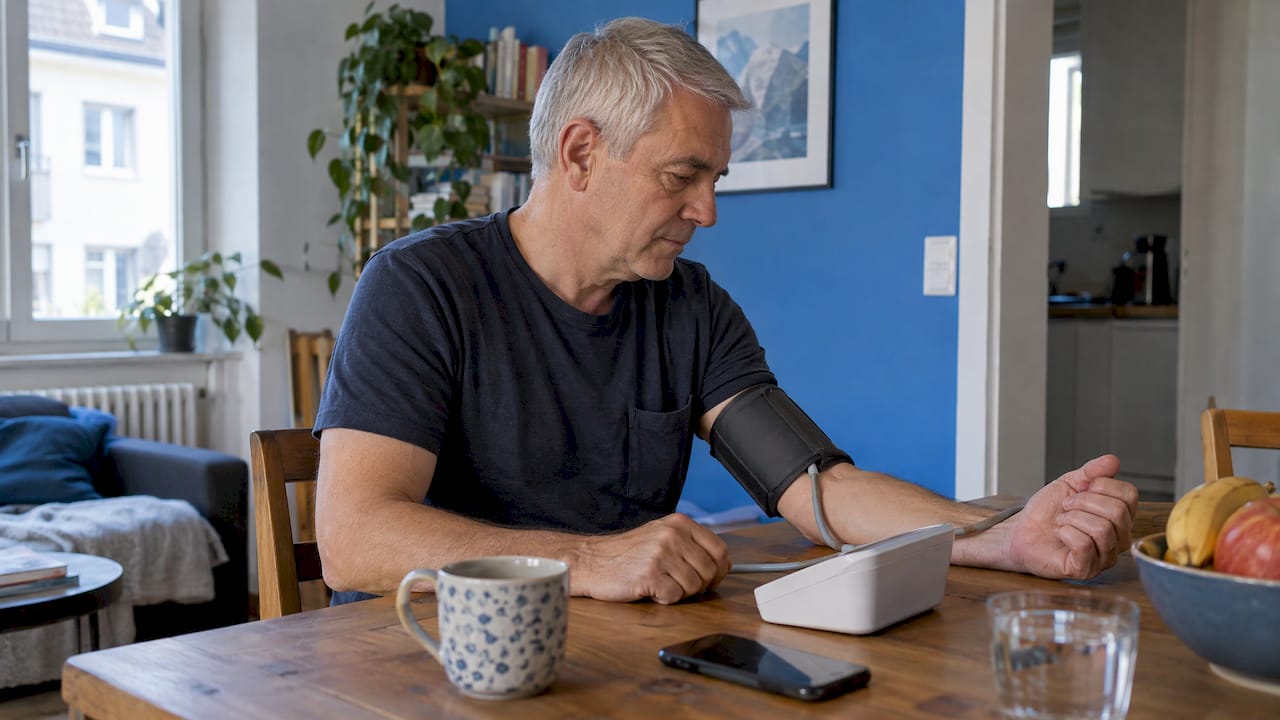
Remote patient monitoring (RPM) means collecting health measurements from a patient outside the clinic, usually with connected devices, and sending them to a care team who review them and act. It suits conditions that can be followed through numbers such as blood pressure, weight or oxygen saturation. Many clinicians, especially in psychotherapy, rehabilitation and research, need something different between appointments: structured content that a patient works through at home. That is blended care, and it is what SwissDTx is built for. This guide explains both, so you can tell which one your service needs.
SwissDTxSupport Care Between AppointmentsSwissDTx helps professionals share structured digital content that patients work through at their own pace between appointments.VisitKey Takeaways
- RPM is a form of telehealth in which digital devices collect data outside the care setting and transmit it to clinicians, who review readings and manage care from them.
- It depends on devices, a clear review routine and escalation rules. The published evidence of benefit is stronger for some conditions (heart failure, COPD, hypertension) than for others.
- Data protection, staffing and integration decide whether a programme works in practice, whether you work under the Swiss nDSG, the GDPR or UK rules.
- Blended care is a different tool: professionals assign structured exercises, psychoeducation and check-ins, and patients complete them at their own pace in an app.
- SwissDTx organises content between appointments. It does not interpret patient information and does not suggest diagnoses or treatment decisions. All clinical judgement stays with the professional.
Table of Contents
- What remote patient monitoring means
- How RPM works day to day
- Devices and measurements
- Conditions and care settings
- What the evidence shows
- Safety, governance and data protection
- What drives the cost
- Where blended care fits
- Choosing the right approach for your service
- SwissDTx for your team
- FAQ
- Sources
What remote patient monitoring means
The US Agency for Healthcare Research and Quality describes RPM as telehealth in which digital medical devices collect patient data outside traditional care settings and send it electronically to providers for care management. The US Department of Health and Human Services adds that RPM is asynchronous: nobody needs to be on a call at the moment the reading is taken. Clinicians look at the data later to manage conditions, spot risks and educate the patient.
That separates it from two neighbours:
- Telehealth visits use phone or video for a live conversation. The American College of Cardiology’s 2024 workbook distinguishes these from RPM and notes that RPM can complement them by adding objective health data. A live session, for example telehealth therapy by video, and a device-based data stream can run side by side for the same patient.
- Telemetry is generally continuous monitoring by clinicians, as on a cardiac ward. RPM is typically periodic, with readings taken daily or a few times a day.
The sources above are American, and the term is used differently in places. In the UK, NHS England uses the language of virtual wards, where remote monitoring technology such as apps and medical devices lets people be cared for at home instead of in hospital. In the US the related billing term is remote therapeutic monitoring, which we cover in a separate article on RTM.
How RPM works day to day
The US Centers for Medicare & Medicaid Services describes a typical workflow in three parts: patient education and setup, device supply and data transmission, and clinical management based on the readings.
In practice that means:
- Enrolment and training. The patient receives a device, learns to use it and understands what will happen with the numbers.
- Data collection. HHS notes that patients commonly record information at least daily, sometimes several times a day, and some wearables transmit readings automatically.
- Clinical review. The same HHS guidance says clinicians, often nurses or other team members, should review readings regularly, contact patients when values are out of range, consider repeat readings, act clinically and educate the patient.
The third step is where most of the cost sits. A device that sends data nobody reads is a risk, not a service. Before you start, decide who reviews, how often, and what happens at weekends and during holidays.
Devices and measurements
CMS lists connected blood-pressure cuffs, weight scales and pulse oximeters as examples. HHS adds devices for heart rate, glucose, sleep, breathing and pregnancy. AHRQ also mentions blood-glucose meters and wearable Holter monitors for heart rhythm. A Canadian procurement toolkit from Canada Health Infoway describes the wider set of peripherals, including wearables, implants, thermometers and glucose meters.
Two practical points follow from this list. First, most of these devices produce a physiological number, so RPM fits conditions where such a number guides care. Second, AHRQ warns that incorrect device use or poor data-collection practice can produce false values. Patient training and technical support are part of the programme, not an extra.
Conditions and care settings
HHS names hypertension, diabetes, weight, heart problems, breathing problems, sleep issues and asthma among the concerns that may be followed through RPM. AHRQ says RPM has historically been used for chronic cardiac conditions, diabetes and asthma, with applications in COPD and congestive heart failure. For a concrete picture of one such condition handled remotely, see this overview of hypertension telehealth management.
NSW Health in Australia describes a trial for people with congestive heart failure and COPD. Patients borrow Bluetooth devices that measure oxygen levels, heart rate, blood pressure or weight, and readings reach the care team through an app.
The Canada Health Infoway toolkit names a wider range of settings: ageing at home, palliative care, cancer care, long-term care, mental health and perioperative care. That breadth is worth reading carefully. Where the need in mental health or rehabilitation is not a physiological reading but structured work between sessions, a different kind of tool applies, which we come to below.
What the evidence shows
HHS lists patient benefits such as engagement, behaviour change, prevention, learning and convenience, including sharing data without travelling to an office visit. For clinical effect, a 2025 overview of systematic reviews from Sweden is the more careful guide. It found some evidence of patient benefit for asthma, COPD, heart failure, hypertension and older people with multiple diseases. For children with complex needs, children with cystic fibrosis, specialist maternity care and sleep apnoea, the evidence was very limited.
The same overview says patient-relevant benefits, clinical risks and costs remain poorly studied for many diagnoses, and that acceptable-quality systematic reviews were missing for seven of the patient groups it selected. For a service lead, the lesson is to match the programme to a population where the evidence exists, and to define in advance what you will measure about the programme itself: enrolment, completion, staff time.
Safety, governance and data protection
AHRQ identifies safety risks including misdiagnosis or failing to identify a patient who needs attention. Its recommendations are concrete:
- Write explicit escalation protocols, so everyone knows who acts on an abnormal reading and how fast.
- Set individualised thresholds, since a value that is normal for one patient may be concerning for another.
- Explain to patients how abnormal results and emergencies will be handled. A patient should never assume that someone is watching in real time when nobody is.
On data, the Canada Health Infoway toolkit advises addressing privacy and security during procurement: safeguards for personal health information, controls against unauthorised activity, compliance with applicable law and security logging. In Switzerland the relevant frame is the revised Federal Act on Data Protection (nDSG), in the EU the GDPR, and in the UK the UK GDPR. Health data counts as sensitive personal data in all three, so involve your data protection officer before any rollout, and ask where data is hosted and who can access it.
Software that is intended by its manufacturer for a medical purpose can fall under the EU Medical Device Regulation. Recital 19 of Regulation (EU) 2017/745 states that software for general purposes used in a healthcare setting is not a medical device, while software specifically intended for a medical purpose is. Whatever tool you consider, read its intended purpose and match it to what you actually plan to do with it.
What drives the cost
The British Columbia Provincial Health Services Authority’s April 2024 white paper says upfront RPM investment can include equipment, software, installation, training, staffing and IT support. It also says cost-effectiveness depends on that investment, on workflow and system integration, and on the clinical circumstances. There is no single price for “remote patient monitoring”, because a hypertension programme with loaned cuffs and a nurse-led review rota costs something quite different from a software-only service. Budget for the staff time to review readings before you budget for devices.
Where blended care fits
Many teams searching for remote monitoring are really asking a related question: how do we support patients between appointments? In psychotherapy, rehabilitation and clinical research, the answer is often not a stream of device readings. It is a structured programme: psychoeducation to read, exercises to practise, short check-ins, videos and other media, assigned by the professional and completed by the patient between sessions.
This is blended care, and it is what SwissDTx provides. Professionals build programs in the Therapy Builder, which now includes an AI assistant that builds, translates and revises program content, and the professional always reviews the result. They manage their patients and the content they share in the Care Cockpit. Patients work through it in the Patient App at their own pace. Programs exist in German, French, Italian and English, which matters in a multilingual country such as Switzerland.
The boundary is clear and worth stating plainly. SwissDTx organises content. It does not interpret patient information, and it does not suggest diagnoses or treatment decisions. All clinical judgement stays with the professional. It is not a replacement for clinical care, and it is not a substitute for the device-based monitoring described above.
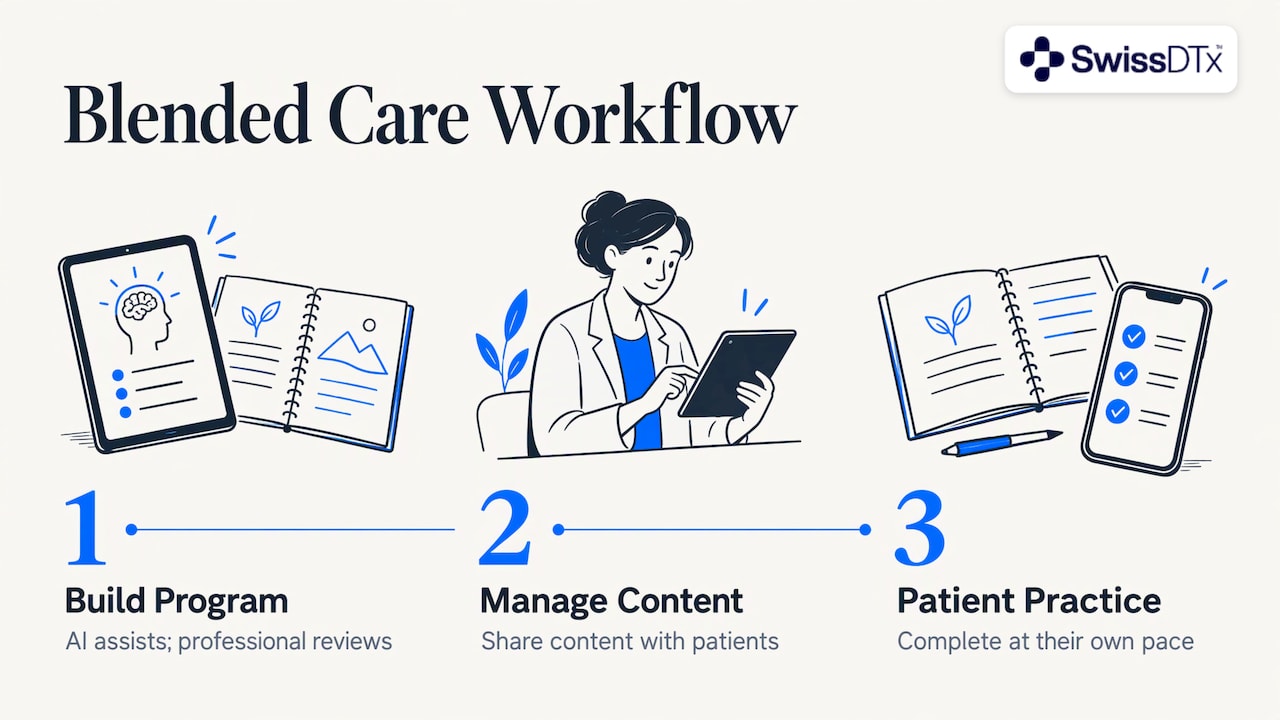
That clarity helps with the governance questions in the previous sections. When a platform only organises and delivers content that you wrote or reviewed, the questions for your team are about content, consent and data handling. You do not need to design thresholds or an escalation rota for readings the platform never judges.
Where teams use it
- Psychotherapy and psychology practices assign exercises and psychoeducation for the weeks between sessions.
- Rehabilitation services share structured material for recovery at home.
- Research teams deliver study content to participants in decentralised clinical trials.
- Hospitals and clinics organise patient content across departments.
If you want to see how the pieces connect, how blended care works walks through the flow from program to patient.
Choosing the right approach for your service
A short set of questions usually settles it:
| Your main need | Typical approach |
|---|---|
| Follow a physiological value such as blood pressure or weight, with a team to review it | Device-based RPM with escalation rules and review staff |
| Talk to a patient live at a distance | Telehealth by phone or video |
| Give patients structured exercises, education and check-ins between appointments, in several languages | Blended care with content built by the professional |
| Deliver study content to participants outside the site | Blended care in a decentralised trial design |
These are not exclusive. A service can combine a live video session, a connected device and a content programme for the same patient, as long as it is clear who is responsible for each part. Whatever you choose, write down who reviews what, how often, and what the patient is told to expect.
SwissDTx for your team
If your need is structured content between appointments, the Care Cockpit is where professionals manage patients and shared content, and the Patient App is where patients work through it. SwissDTx is based in the Canton of Fribourg, Switzerland, and is used by hospitals, clinics, universities and research teams.

You can see the licence options, including the Care Dashboard, Patient-App, Institutional Licenses and Scientific Research, on the licences page.
FAQ
What is remote patient monitoring?
It is telehealth in which digital devices collect patient data outside the clinic and transmit it to a care team. Clinicians review the readings and manage care from them. It is asynchronous, so no live call is needed when the reading is taken.
Which devices are used in remote patient monitoring?
Common examples are connected blood-pressure cuffs, weight scales, pulse oximeters and glucose meters. Wearables for heart rate, sleep and breathing are also used, along with wearable Holter monitors for heart rhythm. Patients need training, because incorrect use can produce false values.
How is remote patient monitoring different from telehealth?
Telehealth visits are live conversations by phone or video. RPM is periodic data collection that clinicians review afterwards. The two can complement each other, and both differ from telemetry, which is generally continuous clinician monitoring.
Is blended care the same as remote patient monitoring?
No. Blended care combines in-person appointments with structured digital content that patients complete between them. SwissDTx supports this by letting professionals organise and share content. It does not interpret patient information, does not suggest diagnoses or treatment decisions, and leaves all clinical judgement to the professional.
Sources
- Remote Patient Monitoring, AHRQ PSNet (2023)
- Getting started, Telehealth.HHS.gov (2024)
- What are different types of telehealth, Telehealth.HHS.gov
- Remote Patient Monitoring, CMS
- RPM Innovation Workbook, American College of Cardiology (2024)
- Remote patient monitoring, NSW Government
- Digital Health Solutions Procurement Toolkit, Canada Health Infoway (2022)
- Clinical benefits and risks of remote patient monitoring, overview of systematic reviews (2025)
- PHSA Remote Patient Monitoring White Paper (April 2024)
- Virtual wards, NHS England Digital
- Regulation (EU) 2017/745 on medical devices