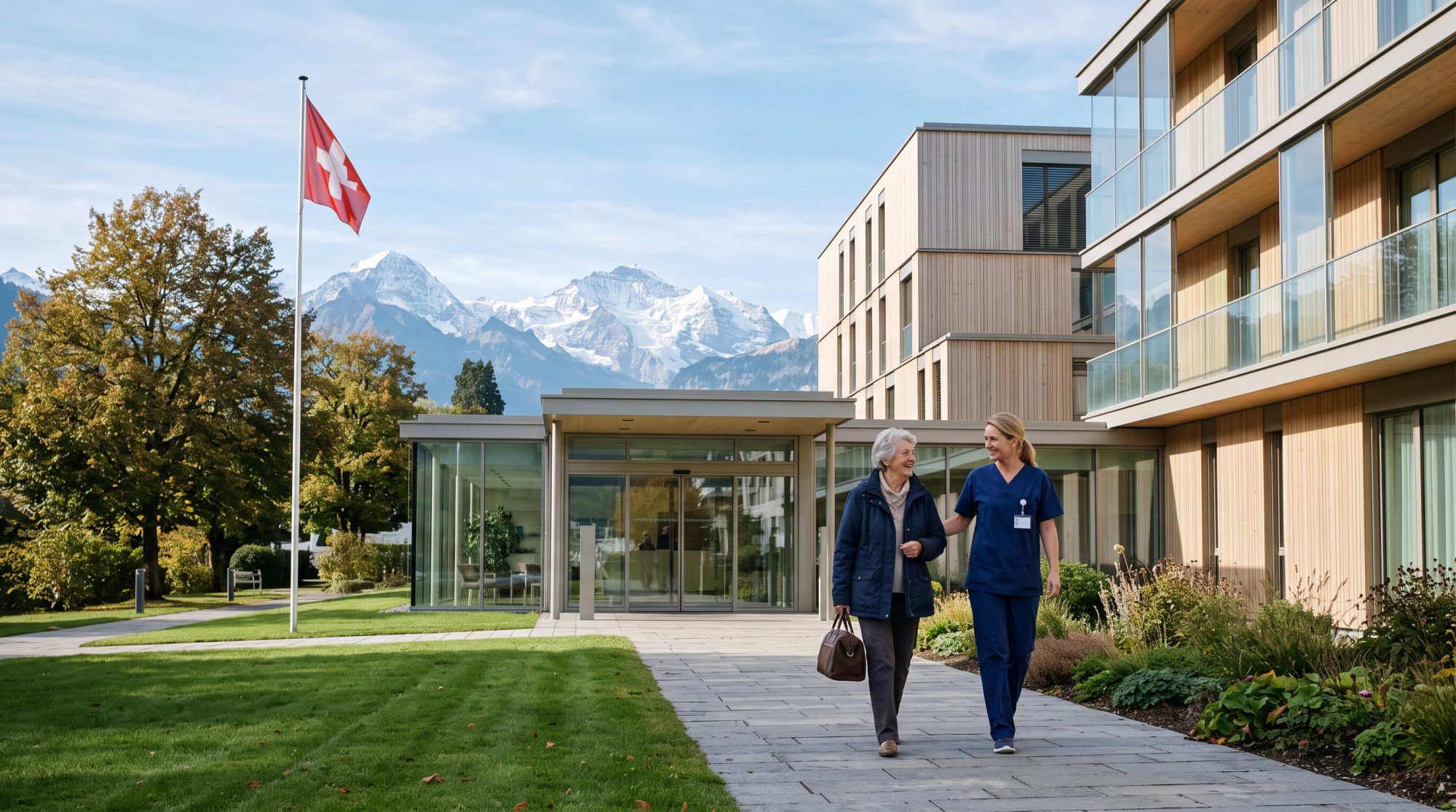
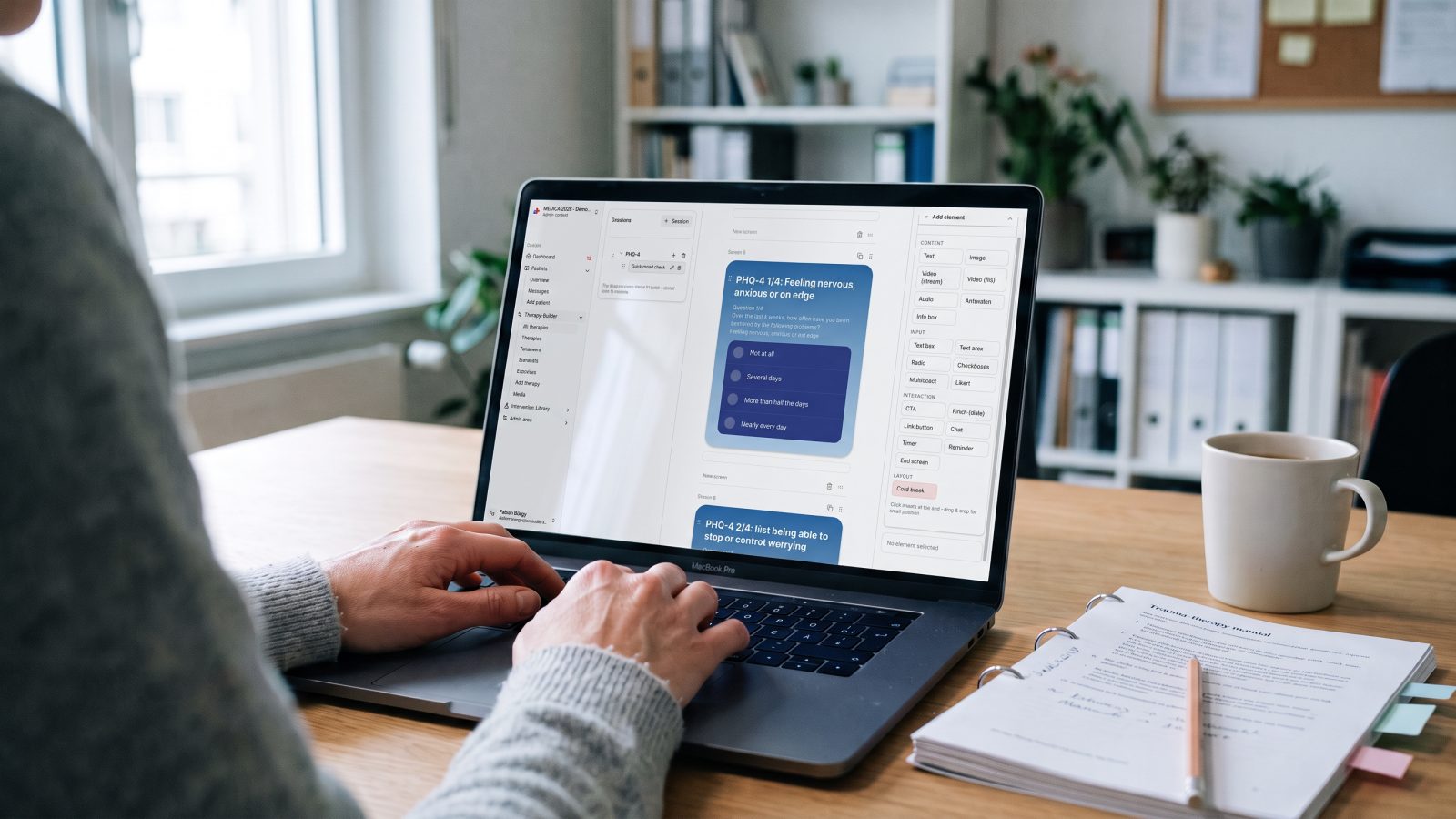
In healthcare, hybrid PT means physical therapy or psychotherapy in which appointments in the practice, ward or clinic are joined by structured digital content that the patient works through between visits.
Search for “hybrid PT” and most results are about personal training: gym coaches mixing face-to-face sessions with online programmes. In a clinical setting the phrase points somewhere else. The professional stays responsible for every clinical decision, and the digital part organises the time between appointments. SwissDTx™ is a blended-care platform built for that purpose: professionals put together structured content and manage patients and shared content in the Care Cockpit, and patients work through it in the Patient App at their own pace. SwissDTx does not interpret patient information and does not suggest diagnoses or treatment decisions.
TL;DR
- Hybrid PT in a clinical setting means in-person sessions plus structured digital content between them, with the therapist deciding what is shared and when.
- Hybrid care is a joint decision with the patient. Guidance from NICE, the US HHS and the Swiss FMH stresses preference, continuity of the therapeutic relationship and the option of in-person care.
- In Switzerland, the revised Federal Act on Data Protection (nDSG), professional confidentiality and the FMH telemedicine guidance shape how a practice sets up digital components.
- The practical work is in the design: what content goes between which sessions, how the patient receives it, and how the professional discusses it at the next appointment.
- SwissDTx organises that content. Clinical judgement stays with the professional.
What hybrid PT means in a clinic, and what it does not
“PT” is ambiguous. In the fitness sector it means personal trainer. In a clinic, PT usually means physical therapy, and in some European settings psychotherapy. The structure is the same in both: a hybrid model combines in-person appointments with remote or digital elements, and the professional and patient decide together what suits each stage.
The US Department of Health and Human Services puts it in similar terms in its telehealth guidance on hybrid care. It describes a combination of virtual and in-person appointments, with a joint decision between patient and provider on whether and when a virtual visit is appropriate. It adds that the approach is especially useful for people who have difficulty getting to the practice or who need frequent care.
The American Psychiatric Association takes a wider view in its guidance on hybrid psychiatrist-patient relationships, covering in-person work alongside remote visits and digital tools such as smartphone apps and web-assisted therapy. Both documents are American and serve here as a comparison. They are useful because they separate three things that are often mixed up:
- Video or phone appointments that replace a visit.
- Administrative tools such as booking systems and patient portals.
- Structured content between visits: exercises, psychoeducation, short reflection questions and multimedia the patient works through alone.
The third is what most clinicians mean when they say blended or hybrid care, and it is where a platform like SwissDTx sits. It does not replace the appointment, and it does not replace the clinician.
Why clinicians combine the two
The interval between appointments is where much of the work happens and where the least structure usually exists. A physiotherapist hands over a printed exercise sheet. A psychotherapist suggests a thought record on paper. Both depend on what the patient remembers and on whether the material suits them. Hybrid PT puts that material in one place, in the right order, in the patient’s own language.
There is research interest in this. A 2026 narrative review of digital rehabilitation, published in Healthcare, notes that the evidence for hybrid delivery is comparatively broader than for some other digital approaches. It also cites a systematic review that found comparable satisfaction and possibly better attendance with real-time telerehabilitation, with low certainty of evidence, and it stresses that remote care is not appropriate for every patient or task. Treat the findings as a map of an active field, not as a promise about any one tool.
In psychotherapy, the question is still being tested. A 2026 protocol in JMIR Research Protocols describes a randomised non-inferiority trial comparing blended cognitive behavioural or psychodynamic therapy with face-to-face psychotherapy for depression. That is a fair picture of where the field stands, and a reason to design each programme with care.
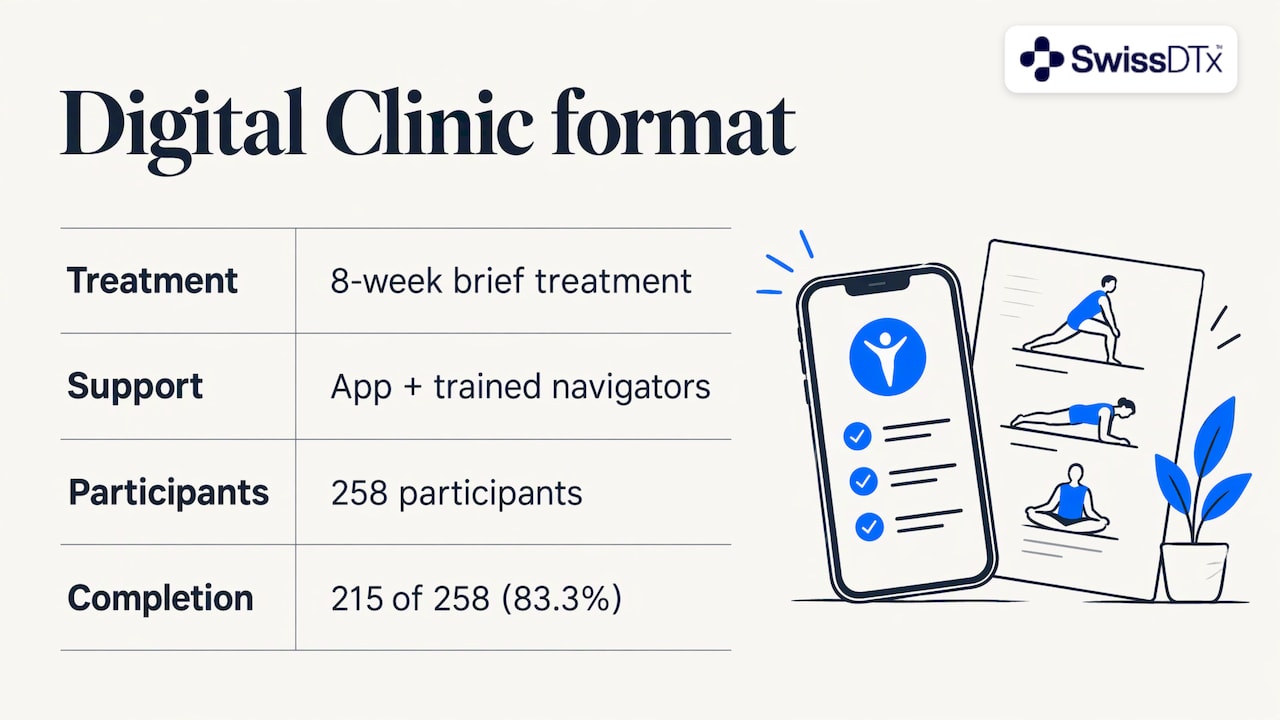
A US example shows what a structured hybrid model can look like. An open trial of the Digital Clinic, published in JMIR Mental Health in 2025, combined an eight-week brief treatment with a smartphone app and a digital navigator. Of 258 participants, 215 (83.3%) completed the programme. The study is nonrandomised and the setting is American, so it illustrates the format, not a result to expect in a Swiss outpatient service.
Which patients and situations suit a hybrid model
No model suits every patient. The useful question is which parts of a treatment pathway benefit from face-to-face contact and which can be carried by structured content.
NICE guideline NG236 on adult stroke rehabilitation, published in October 2023, is a good UK reference. The rationale in the guideline found telerehabilitation beneficial for quality of life and activities of daily living, but recommends it only where it is the person’s preferred option. It also asks that the therapist-patient relationship is maintained, with in-person therapy available if needed, and that equipment is provided to people who lack it. Those conditions translate well to any hybrid service:
- Preference first. Offer the digital component, do not assume it.
- Continuity. The same therapist runs both the sessions and the content.
- Access. A patient without a suitable phone or a stable connection needs a plan before the programme starts.
- A route back to the room. Some situations and some days call for in-person contact.
In practice, clinicians tend to find hybrid PT a natural fit for:
- Psychotherapy where psychoeducation and exercises between sessions are part of the method. See blended care for psychotherapy.
- Rehabilitation where home exercises, education and multimedia support the sessions at the practice. The rehabilitation page describes this use.
- Patients who live far from the service or who need frequent contact, the group the HHS guide singles out.
The question of home programmes versus clinic work is not new. One clinic’s discussion of home programmes versus in-clinic physiotherapy shows the kind of trade-offs patients raise with their therapist, and why the decision belongs in the consultation.
Whether in-person care is needed is a clinical judgement. The platform does not make it, and neither does any content library. If a patient tells you something that changes your assessment, the response is a conversation with the patient, in the room or by phone, according to your own protocols.
Designing the between-session part
The digital part of hybrid PT works when it is designed like a treatment plan, not like a document dump. A workable sequence:
- Define the purpose of the interval. What should the patient do, read or practise before the next session? Keep it to a few items.
- Choose the content type. Psychoeducation for understanding, exercises for practice, short reflection questions for the patient’s own notes, multimedia for demonstration.
- Order it. Put items in the sequence you would use in a session, and release content in step with the appointments.
- Match the language and level. In Switzerland, a patient may be more comfortable in French or Italian than in German.
- Discuss it at the next appointment. What the patient did, what was unclear, what to change. This is where the clinical work happens, and it stays with you.
This is where the SwissDTx Therapy Builder helps. You build the programme as structured content, and an AI assistant can help build, translate and revise programme content. You always review the result before it reaches a patient. The assistant works on content only. It does not interpret patient information and does not suggest diagnoses or treatment decisions.
What Swiss and European rules ask of a practice
A hybrid service raises the same legal questions as any telemedicine service, and the Swiss answers are specific. The FMH telemedicine guidance of February 2026 sets out several points a practice should know:
- Telemedicine must meet the same professional duties and medical standard as in-person care.
- A personal relationship between physician and patient should be maintained as far as possible.
- Patients must be told the type and purpose of the telemedicine use and must agree to it, and both the information and the consent are documented in the medical record.
- Records must be kept for 20 years in line with the Code of Obligations (OR), subject to cantonal law.
The same guidance covers data protection under the revised Federal Act on Data Protection (nDSG, in force since 1 September 2023). Depending on the scope of processing, a data protection impact assessment may be required, for example when an existing practice newly offers telemedicine. ICT providers should be subject to Swiss or European law, with jurisdiction in Switzerland. If data are stored somewhere not covered by the Swiss act, patients must be informed in writing and agree to the processing.
A Walder Wyss overview of Swiss digital health law adds context. Health data count as sensitive personal data under the Swiss act, and healthcare professionals remain bound by professional confidentiality under article 321 of the Swiss Criminal Code.
For practices that treat patients from EU member states, the GDPR applies in parallel, and the differences matter in cross-border work. Your data protection officer or legal adviser should settle the specifics for your service, and the impact assessment is the document in which you record them.
For the operational side, the HHS guide on developing a hybrid care strategy offers a practical checklist, again as an American comparison. It suggests defining protocols for switching between remote and in-person visits based on the patient’s condition, preferences and information needs, setting aside time blocks for virtual consultations, and preparing rooms with privacy measures and technical support.
A worked example: a hybrid pathway in a physiotherapy practice
Take a practice that treats patients after shoulder surgery. The pathway might run over twelve weeks.
| Phase | In the practice | Between appointments |
|---|---|---|
| Weeks 1 to 2 | Assessment, first exercises, explanation of the plan | Short education module, demonstration videos for two exercises |
| Weeks 3 to 6 | Hands-on work, progression of exercises | Exercise sets released in order, a short reflection question where the patient notes how the practice went |
| Weeks 7 to 12 | Functional training, discharge planning | Longer exercise programme, material on returning to everyday activity |
The therapist decides every row of this table. The platform holds the content and presents it in the patient’s language. The therapist discusses the patient’s own notes at the next session and decides what they mean. SwissDTx does not interpret them or draw conclusions from them.
The same shape works in psychotherapy: a session on a cognitive model, a psychoeducation module and a worksheet for the days after, then the next session builds on the patient’s own words. For more on the idea, see the article on blended therapy and human connection.
Where SwissDTx fits
SwissDTx™ is a Swiss blended-care platform for psychotherapy, rehabilitation, clinical research and corporate health. Three parts matter to a hybrid PT service:
- The Therapy Builder, where professionals assemble structured programmes of psychoeducation, exercises and multimedia, with an AI assistant that helps build, translate and revise content for their review.
- The Care Cockpit, where professionals manage their patients and the content they share with them.
- The Patient App, where patients work through the content at their own pace.
The page on how blended care works walks through the flow. Teams and institutions can compare options on the licences page, and research teams can look at the decentralised clinical trials use case.
The boundaries are as important as the features. SwissDTx organises the time between appointments. It does not interpret patient information and does not suggest diagnoses or treatment decisions. All clinical judgement stays with the professional.
Starting a hybrid service: a short plan
- Pick one pathway. Choose a single patient group where you already send material home, such as post-operative physiotherapy or a structured psychotherapy protocol.
- Write the content map. List what each interval needs, then build it in the Therapy Builder and review it as you would any patient handout.
- Settle the legal basics. Prepare your consent wording and documentation, check whether a data protection impact assessment is required under the nDSG, and confirm where data are processed, following the FMH guidance above.
- Brief the team. Agree who releases content, who talks to patients about it and when it is discussed in the session.
- Ask patients what they prefer. NICE’s emphasis on preference applies beyond stroke care. Some patients will want more digital content, others less.
- Review after a few months. Look at what patients used, what they found unclear and which content you changed.
FAQ
What does hybrid PT mean in healthcare?
It means physical therapy or psychotherapy that combines in-person appointments with structured digital content between them. The professional decides what is shared and discusses it with the patient. It is not the same as hybrid personal training in the fitness sector, though both mix face-to-face and online work.
Does hybrid PT replace face-to-face sessions?
No. The model rests on the appointment, and the digital part supports the time between sessions. Guidance such as NICE’s stroke rehabilitation recommendations keeps in-person therapy available whenever it is needed.
What does a Swiss practice need to consider for data protection?
The FMH telemedicine guidance asks for documented patient information and consent, record keeping for 20 years in line with the OR and, depending on the scope of processing, a data protection impact assessment under the nDSG. Professional confidentiality under article 321 of the Criminal Code continues to apply. Your data protection officer or legal adviser can confirm what applies to your service.
Does SwissDTx interpret what patients enter in the app?
No. SwissDTx does not interpret patient information and does not suggest diagnoses or treatment decisions. Professionals look at what patients have done and decide on any clinical step themselves.
Sources
- US HHS: Introduction to using telehealth in hybrid care
- US HHS: Developing a strategy for hybrid care
- American Psychiatric Association: Hybrid Psychiatrist-Patient Relationships
- NICE NG236: Stroke rehabilitation in adults, rationale and impact (2023)
- FMH: Merkblatt zur Durchführung von Telemedizin (2026)
- Walder Wyss: Panoramic Digital Health, Switzerland
- Digital Transformation of Rehabilitation Care, Healthcare (2026)
- BLENDED Study protocol, JMIR Research Protocols (2026)
- Open Trial of the Digital Clinic, JMIR Mental Health (2025)
- Home physical therapy versus in-clinic programmes